
Featuring Brian “Red” Hamilton – Head Equipment Manager, Vancouver Canucks
SPHEM: What inspired you to pursue a career in equipment management, and how did you get your start?
RH: I was 13 when my dad, who was an executive for Minor Football in our hometown of Richmond, BC, asked me to help with the equipment for the BCJFL Richmond Raiders. A close family friend, Creighton O’Malley, the Equipment Manager for the BC Lions at the time, took me under his wing. My dad arranged for me to spend some time with Creighton and his staff to learn the ropes, and I ended up staying with the Lions instead. Creighton wanted me on his team, so I never ended up helping the Raiders.
SPHEM: You began your career with the BC Lions of the Canadian Football League. Can you tell us about your transition to the Canucks?
RH: Yes, I spent 13 years working with the BC Lions, and Jon Sanderson also worked at the BC Lions before he was hired by the Canucks. After the 2001 CFL season, I left the Lions to work in the “real world.” But a short time later, the Canucks needed a game-night staffer, and Jon passed my name along to Pat O’Neill. Next thing I knew, I was working game nights for the Canucks and The Queen was dropping the puck at GM Place. It was quick! I moved into a full-time role with the Canucks Equipment department at the start of the 2005/2006 season. I’ve always said that the only thing football and hockey have in common is laundry; football is all about working a whole week for one game, while hockey is about getting ready for whatever’s happening tomorrow.
SPHEM: This season, you’ve stepped into the role of Head Equipment Manager, succeeding the highly respected Pat O’Neill. What’s the best piece of advice Pat passed along as you began this new chapter?
RH: Be prepared. He was so prepared for any situation. Ordering, travel, or day-to-day, he could read the situation and anticipate what was coming, and because of that we were always prepared and not often caught off guard. It also allowed us time to deal with the unexpected because we weren’t running around.
SPHEM: Even though you’ve only recently taken on the Head Equipment Manager role, what advice would you give to an Assistant hoping to one day move into that position?
RH: Be a great assistant and understand how to support your Head Equipment Manager. That’s what I’m most proud of as an assistant. Be patient, stay positive, and enjoy doing what you love. Support your Head Equipment Manager and good things will happen.
SPHEM: So far, what has been the biggest surprise about serving as Head Equipment Manager?
RH: Thinking back to Pat and the advice he gave me, there haven’t been many surprises. He really prepared me for this. And it wasn’t just him; I’ve been lucky to learn from a lot of great people along the way. One of the biggest advantages of staying with the same organization is the familiarity – I know where everything is and I get to work with people who consistently support the equipment department. Working with Mac, Brodie, and Johhny have made the transition not only smooth but fun!
SPHEM: You recently joined us on the PHATS/SPHEM podcast and shared the remarkable story of how a Seattle Kraken fan helped you detect melanoma early—an experience that not only changed your life but also inspired the creation of several organizations and fundraisers to give back. Since then, has your outlook on life and career shifted? If so, how? And what advice would you share with others working in fast-paced, often stressful careers?
RH: This is a tough question to answer because I get emotional. If Nadia had not caught my attention that night in Seattle, I am now at the point, almost five years later, that my melanoma would’ve likely been fatal. I was recently diagnosed with melanoma again, which was once again caught early enough that it didn’t spread. I am living the benefits of early detection!
I’m not alone though. Other SPHEM members are going through so much worse right now, and I’m sure there’s many others facing health challenges that we don’t even know about. My outlook hasn’t changed too much, as I’ve always enjoyed being where my feet are. It sounds silly, but when I’m at work I enjoy every second, and when I’m with my family, I enjoy every second.
Jess and I also partnered with Melanoma Canada after my first diagnosis because we wanted to help raise awareness and funds for this deadly form of skin cancer. To be honest, we really didn’t know much about it before my diagnosis and have since learned that middle-aged men in BC have the highest rate of melanoma in Canada. As a result, we proudly launched the Jess & Red Hamilton Fund alongside Melanoma Canada and we have since helped raise over $200,000 which helped bring the Mole Mobile to British Columbia the last two summers (a mobile dermatology unit that travelled across BC for free, walk-in skin assessments) and helped launch the Sun Guardians program which provides kids sports leagues, camps, daycares, and rec centres with free UV protective clothing, sunscreen, shade structures and more.
SPHEM: Traditions and rituals go hand-in-hand with sports. What’s your game day ritual, or your lucky charm?
RH: I get a text from my wife moments before the start of every game. It’s something she started doing years ago and now I look forward to it.
SPHEM: The hours, travel, and demands of the season can be intense. What keeps you motivated?
RH: The anticipation that you never know what the next question is. We never know who is going to walk into our room and what they are going to ask so we must be prepared for everything. Every day is different. Also, the people we meet are a big part of it. Going into cities and seeing great people makes the travel easier and exciting.
SPHEM: Who have been your mentors over the years, and what is the best advice they’ve shared with you?
RH: I worked for and with the following great people: Pat O’Neill, Darren Granger, Mike Burnstein, Jon Sanderson, Creighton O’Malley, Kato, Bill Reichelt, Larry Ashley, and John Forget. When I drove the truck I developed relationships with Mike Aldrich, Stan Wilson, Pete Rogers, Barry Stafford, the list goes on. They all took time to help me along the way. I look at that list and feel so fortunate. The relationships that I’ve made with current staff around the league and other leagues is a huge resource for me and all of us in the equipment department.
SPHEM: On the podcast, you also spoke about the importance of working in your hometown. Can you talk about the value of having a strong support system at home during the season?
RH: It’s all I know to be honest. I have my family here and I feel really lucky to work for my hometown team. My family is my number one. Jess is my rock, and my daughter Ashley is my biggest fan – and I’m her biggest fan. Jess’s kids, Bennett and Avyn make us a loving and busy family of five. Jess and I are also really fortunate to have a tight network of friends that we consider to be extended family who live nearby. We all help each other out, and they are amazing at helping Jess with the kids or the house when I am on the road.
SPHEM: Tell us a little about yourself—your family, hobbies, and life outside of hockey.
RH: My family is my life outside hockey. My hobbies are family oriented as well. I’m the Assistant Coach for Ashley’s U19 Rep Softball team, Jess is the Assistant Coach for Avyn’s U13 Rep Softball team, and Bennett is a baseball umpire. We spend 7 days a week at the ball field during the hockey off-season. I also value my local friendships so much, so we try to spend as much time as possible with our family friends (aka, extended family) during our free time. I’m also a huge NFL fan, and LOVE the Seahawks.
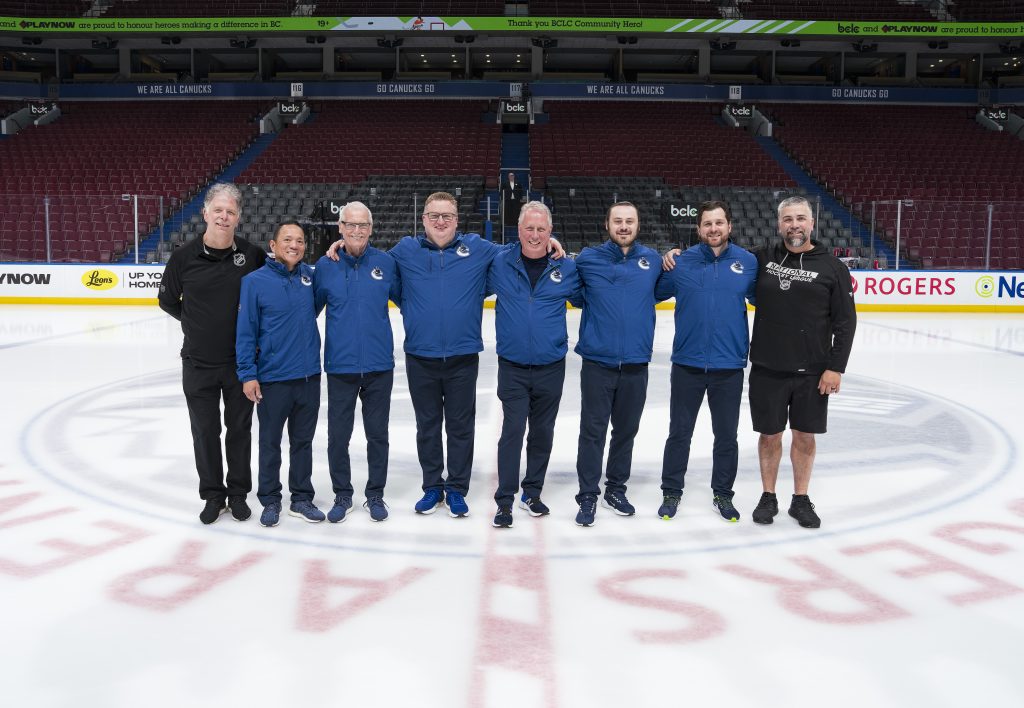

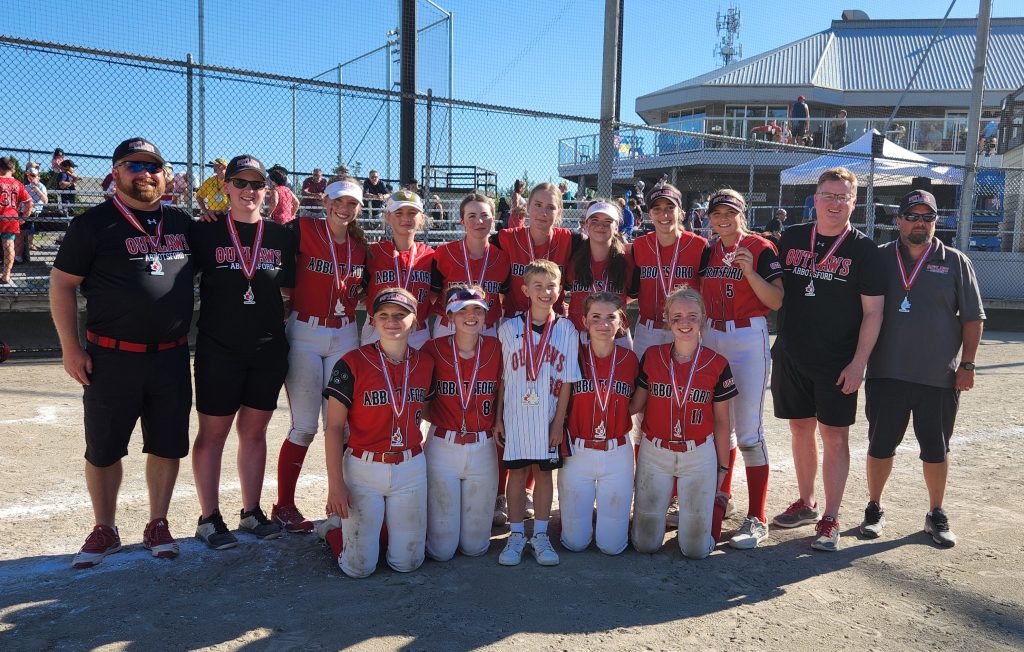
All photos courtesy of Red Hamilton
Jon Sanderson, Head Athletic Therapist, Vancouver Canucks
PHATS: What made you want a career in the athletic training profession and how did you get your start?
JS: It was a way to combine sports medicine and stay involved as part of a team. Like a lot of us I started out by volunteering and helping out wherever I could to get experience.
PHATS: You were previously with the BC Lions of the Canadian Football League. What is something you learned while working in Football that you?ve brought to the hockey world that you may not have seen without that experience?
JS: The staff then was Billy, Kato, Red, me and Bob Park, who was the strength guy. 5 people to look after a football team and coaching staff, if one of the 5 of us didn?t do it then it didn?t get done. You learn to work hard and be part of a group. We had a great time though, Red and I still laugh about it.
PHATS: How do you see the role of the athletic trainer in professional hockey changing in the next 5-10 years?
JS: It?s so specialized now that day to day treatment, long term rehab, movement screening/correctives, dealing with each players individual ?team?, monitoring other players in the organization, dealing with doctors, specialists, insurance? these and others will be individual areas that the Head Athletic Trainer manages and coordinates under the umbrella of the Medical Department. That and on ice emergency care during games.
PHATS: You?ll reach 1,500 games this year, congratulations! What does this accomplishment mean to you?
JS: That I?ve been fortunate to work with great people, the best part about this job is we do it together.
PHATS: Travel is such a huge part of this profession. What is one of your favorite hockey cities to visit and why?
JS: Chicago, you can walk to all the shopping and restaurants downtown. The United Center is great to work in and the atmosphere is like no other city. And Pippens.
PHATS: Can you recommend any type of schooling, courses, or training that would benefit a young athletic trainer trying to break into this field given the way sports has changed so much over the years?
JS: Some sort of people managing skills and customer service. We?re now in the people business/service industry, athletic training is just the medium that we use.

VANCOUVER, BC – MARCH 26: Medical trainer Jon Sanderson tapes the wrist of Jake Virtanen #18 of the Vancouver Canucks during their NHL game against the Anaheim Ducks at Rogers Arena March 26, 2019 in Vancouver, British Columbia, Canada. (Photo by Jeff Vinnick/NHLI via Getty Images) 
VANCOUVER, BC – JANUARY 13: Roberto Luongo (L) #1 of the Florida Panthers talks with Vancouver Canucks medical trainer Jon Sanderson before their NHL game at Rogers Arena January 13, 2019 in Vancouver, British Columbia, Canada. (Photo by Jeff Vinnick/NHLI via Getty Images)
PHATS: You are a regular at our conferences, besides the educational component, what would you say you benefit from most by attending year after year?
JS: The informal conversations with other Trainers. We all have similar jobs but it?s always interesting to hear how other teams problem solve and adapt to their particular situation. I always learn something that can make our staff better.
PHATS: Do you have a professional mentor or Athletic Trainer/Therapist you admire?
JS: When I was going to school at Sheridan for Athletic Therapy I came home every summer to work. My first summer back I called Billy with the Lions because I knew he was a Sheridan grad and asked if I could help out to get some experience. Every summer he let me do everything from treatments to taping, while I was there I watched how he ran the training room, how he interacted with coaches and players and how he handled difficult situations, he taught me what it takes to be a trainer in pro sports. I was lucky he took time for me, he?s not just a great trainer, he?s a special person.
PHATS: What is one thing other Members would be surprised to know about you?
JS: I?m an open book.
Tell us about yourself, your family and your hobbies.
Married to my wife Catherine, we have 2 kids, Kate and Cooper and a dog named Bob. I grew up in Vancouver and enjoy playing golf in the summer.
Photos courtesy of Jon Sanderson.